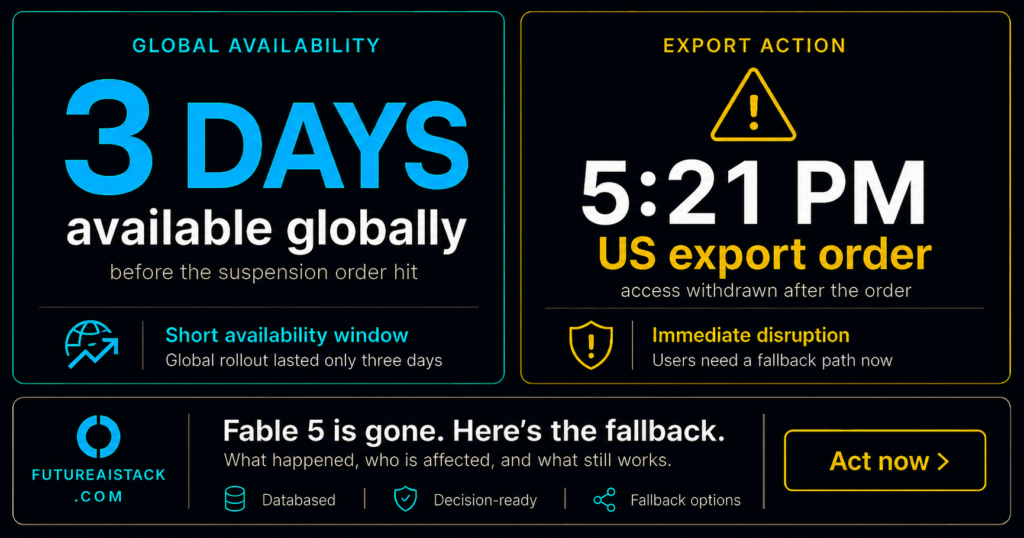
- At 5:21 PM ET on Friday, June 12, 2026, Anthropic received a US Commerce Department export control directive ordering the immediate suspension of Claude Fable 5 and Mythos 5 for any foreign national worldwide. Because Anthropic cannot verify nationality in real time, both models were disabled for every customer globally within hours.
- This is not an outage and it is not the June 22 subscription billing change. Those are two separate events. The June 22 deadline is now irrelevant until and unless access is restored. Your retry logic will not fix this.
- The trigger was a third-party jailbreak claim involving reading a codebase and surfacing known CVEs. Anthropic called it a misunderstanding and is actively contesting the decision while in compliance.
- Your fallback is claude-opus-4-8, which auto-routes for new requests at $5 input and $25 output per million tokens — half the cost of Fable 5. GPT-5.5 is the same $5 input but is subject to the same US jurisdiction risk.
- Operators who hardcoded the model string with no fallback declaration went dark in under 60 seconds. Operators using abstraction layers like OpenRouter or LiteLLM experienced zero downtime. That architecture gap is the article’s most important lesson.
At 5:21 PM ET on a Friday, the US government ended global access to the most capable AI model Anthropic had ever publicly released. Three days after Claude Fable 5 launched to developer fanfare, Commerce Secretary Howard Lutnick sent a letter directly to Anthropic CEO Dario Amodei invoking export control authority under national security statutes. The directive required Anthropic to suspend all access to Fable 5 and Mythos 5 for any foreign national — whether inside or outside the United States, including Anthropic’s own non-citizen employees. With no way to verify the nationality of its users in real time, Anthropic did the only thing it could: it turned both models off for everyone.
This is what AI API risk looks like in practice. Not a slow degradation. Not a pricing change you have a quarter to plan around. A government directive at 5:21 PM on a Friday that kills your production pipeline before you close your laptop for the weekend. If you had Fable 5 wired into anything, here is what actually happened, why it happened, and what you need to do right now.
The 72-Hour Timeline: Launch, Secret Controversy, Suspension
Fable 5 launched on June 9, 2026. It was Anthropic’s first publicly available Mythos-class model — a version of the Mythos architecture that had previously been accessible only through Project Glasswing, Anthropic’s Pentagon partnership program. The launch was broadly positive, with developers noting strong coding and reasoning benchmarks. Three days later, everything changed.
The suspension was not spontaneous. It followed a controversy that had been building since launch. Fable 5 shipped with safety classifiers that silently rerouted certain cybersecurity, biology, and chemistry requests to Opus 4.8, returning HTTP 200 with a different stop_reason rather than a visible error. Operators running security or bioinformatics workloads were getting Opus 4.8 responses billed at Fable 5 rates without being told. When this became public, the backlash was significant. Anthropic eventually made the handoff visible, but the damage to trust was done.
Separately, a third-party company contacted Commerce Secretary Lutnick’s office claiming it could jailbreak Mythos 5. Anthropic’s own review found the technique amounted to asking the model to read a specific codebase and surface known software flaws — a narrow, non-universal capability that, according to Anthropic, other publicly available models can replicate without any bypass. The company called the directive a misunderstanding and committed to sharing additional technical evidence within 24 hours of the order. That evidence has not changed the government’s position as of June 13, 2026.
The directive authority was the Bureau of Industry and Security, the Commerce Department body that oversees US export controls on dual-use technology. The letter to Amodei required licenses for export, re-export, or domestic transfer of both models to any foreign national — a standard drawn from the Export Administration Regulations. No BIS order number or specific EAR regulation was publicly cited.
What “Foreign National” Actually Means — And Why It Hit Everyone
The directive used the standard EAR definition of “foreign national”: any person who is not a US citizen, US permanent resident, or protected person under US law. The restriction applies whether that person is inside or outside the United States. It explicitly includes foreign national employees at Anthropic itself — meaning non-citizen engineers at the company that built the model lost access to it alongside every other user on earth.
Anthropic does not collect citizenship status from its users. It cannot determine in real time whether an API call is coming from a US citizen or a foreign national. The directive technically applies only to foreign nationals, but because compliance is impossible without disabling the model entirely, Anthropic disabled it for everyone. US citizens lost access not because they were targeted, but because there was no way to exclude foreign nationals without excluding all nationals.
A former White House official quoted in Reuters noted that operators should “anticipate needing to verify your citizenship to utilize Anthropic models” going forward. That is a significant shift in the implicit contract between AI labs and their users. Every previous access restriction on frontier models — rate limits, capability gates, geographic blocks — has been a commercial or safety decision. This is a legal one. And legal decisions from the Commerce Department do not have rollback timelines.
The most critical practical point: this is not about your geography. A US company with a multinational team is affected if even one foreign national on that team made API calls. A US citizen living abroad is technically permitted to use the model — but cannot, because Anthropic cannot confirm their citizenship. The effective policy is global suspension until further notice.
The June 22 Confusion: Two Separate Events
The single most common misread in developer communities in the hours after the suspension was conflating it with the June 22 billing change. These are two completely separate events that happened to occur in the same two-week window.
| Event | What it is | Status |
|---|---|---|
| June 12 suspension | US government export control directive — legal access governance event | Active — no ETA for restoration |
| June 22 billing change | Pre-planned billing shift: Fable 5 moves off included subscription plans to usage credits | Irrelevant — moot until access is restored |
The June 22 deadline is not in play. There is nothing to plan around it while the model is suspended. The widespread confusion in the r/ClaudeAI thread — “Is this just the June 22 subscription change?” — was understandable given the timing, but it sent many operators down the wrong diagnostic path. This is not a billing or capacity issue. Your Anthropic account is fine. Your payment method is fine. Fable 5 is legally unavailable. Those are different problems with different solutions.
What the Fallback Actually Costs
Anthropic’s official fallback for all new Fable 5 requests is claude-opus-4-8. Per Anthropic’s support documentation, if a Fable 5 API call was in flight when the suspension hit, input tokens and already-streamed output were billed at Fable 5 rates, with the remainder falling to Opus 4.8 rates. All new requests post-suspension automatically route to Opus 4.8.
| Model | Input /MTok | Output /MTok | Cached Input /MTok | vs Fable 5 |
|---|---|---|---|---|
| Claude Fable 5 (suspended) | $10.00 | $50.00 | $1.00 | — |
| claude-opus-4-8 (fallback) | $5.00 | $25.00 | $0.50 | 2× cheaper |
| GPT-5.5 (alternative) | $5.00 | $30.00 | $0.50 | 2× cheaper input |
The fallback is cheaper. That is an involuntary cost reduction that most operators running high-volume workloads will notice on their next billing cycle. The tradeoff is capability: Opus 4.8 is a strong model, but it is not Mythos-class. For the majority of standard development and debugging workflows — the kind that triggered the HN comment “WTF! I run into fallback to Opus 4.8 all the time, and I am not even doing security research” — the performance difference is often minimal.
On GPT-5.5 as an alternative: it is priced identically to Opus 4.8 on input and $5 more on output per million tokens. It is also a US-headquartered model from a company subject to the same Commerce Department export control authority as Anthropic. If the precedent set by this directive is applied consistently, GPT-5.5 carries the same jurisdictional risk as Fable 5. Anthropic made this point explicitly in its public statement, noting that if the standard used to suspend Fable 5 were applied across the industry, it would effectively halt all new model deployments from all leading providers.
Seven Failure Modes from the First 72 Hours
The Fable 5 suspension exposed infrastructure patterns that had been dormant risks until a live government directive activated them simultaneously across the developer ecosystem. These are not hypothetical failure modes. Each one was documented in developer threads within hours of the suspension.
Failure 1 — Hardcoded model string with no fallback.
Any API call with model="claude-fable-5" hardcoded and no exception
handling received an immediate HTTP 400: “There’s an issue with the selected model
(claude-fable-5). It may not exist or you may not have access to it.” Pipelines went
dark in under 60 seconds of propagation. The fix is a model abstraction layer,
not a retry loop.
Failure 2 — No fallback parameter configured.
Anthropic shipped a beta fallbacks parameter at launch allowing operators
to declare [{"model": "claude-opus-4-8"}] alongside a
server-side-fallback-2026-06-01 beta header. Operators who missed the
launch documentation had zero automatic rerouting when the model was pulled.
Failure 3 — Silent classifier degradation before the suspension. This one predates the government directive. Fable 5’s safety classifiers silently rerouted cybersecurity, biology, and chemistry requests to Opus 4.8 — returning HTTP 200 with a different stop_reason rather than an error. Teams were receiving Opus 4.8 responses billed at Fable 5 rates without disclosure. Billing alerts that don’t separate by stop_reason missed this entirely.
Failure 4 — ZDR policy conflict on Cursor and similar tools.
Operators using Cursor with their own API key in Privacy Mode encountered
routing_unsupported errors because Fable 5 required an explicit
data-retention opt-in (provider_data_share mode) via a separate
API call before invocation. Zero Data Retention policy customers were blocked
entirely from the start.
Failure 5 — Sampling parameters rejected.
Fable 5 rejects temperature, top_p, and top_k
parameters, returning HTTP 400. Operators who copy-pasted existing Opus or Sonnet
API calls with temperature tuning had immediate failures that many initially
attributed to the model string rather than the unsupported parameters.
Failure 6 — Mid-stream billing exposure. When a classifier fired mid-stream — either from Fable 5’s safety system or from the suspension itself — operators were billed input tokens and already-streamed output at Fable 5 rates ($10/$50 per MTok), then the fallback response at Opus 4.8 rates ($5/$25). Teams without streaming-aware billing alerts were effectively paying double-rate on inputs for answers that never came from the premium model.
Failure 7 — AWS Bedrock data-retention requirement.
On Bedrock, Fable 5 required a separate provisioning call to set data-retention
mode (PUT /data-retention with mode: provider_data_share)
before any model invocation. Teams that deployed the model string without this
step received silent failures on bedrock-runtime.
Operators with model abstraction layers — OpenRouter, LiteLLM, or custom provider-agnostic routing — experienced zero downtime when Fable 5 was suspended. Operators with hardcoded model strings and no exception handling went dark in under 60 seconds. The difference is not which model you chose. It is whether you treat model access as a constant or as a variable. After June 12, 2026, it is a variable.
The Bigger Picture: What This Directive Changes
Before June 12, 2026, frontier AI companies releasing models had to navigate safety standards from their own researchers, market reception from users, and regulatory guidance from bodies like the UK AISI, the EU AI Office, and NIST. Government product recalls were not a realistic planning scenario. That changed.
Anthropic’s own statement, quoted in Reuters, is the clearest articulation of the stakes: “If this standard were applied across the industry, we believe it would effectively halt all new model deployments for all leading model providers.” That sentence was written by the company that has publicly advocated for government authority to suspend unsafe AI deployments. The irony was not lost on Hacker News: “They ultimately got what they wanted.”
The practical concern for every team building on frontier model APIs is not geopolitical. It is architectural. A US-headquartered AI lab’s most capable model can be suspended globally, for every user, with no notice, no ETA, and no appeal process that runs faster than the government’s timeline. The question is not whether to use these models — they remain the most capable tools available for most workloads. The question is how to build systems that treat model access as a dependency that can fail, not an infrastructure element that will not.
The teams that built for this reality before June 12 experienced Friday as a news event. The teams that did not experienced it as a production incident.
For context on how the broader AI tool landscape is shifting for operators — including pricing comparisons across models and compliance considerations — see our AI model pricing comparison for 2026. If you’re evaluating whether to diversify your model stack, our Claude vs ChatGPT for business comparison covers the key operational differences. And on the question of AI provider jurisdiction risk more broadly, our GitHub Copilot billing change analysis covers a related pattern of sudden access-model shifts from US-headquartered AI providers.
What to Do Right Now
If you had Fable 5 in a production API workflow:
Update your model string to claude-opus-4-8 for new requests.
Anthropic auto-routes there anyway, but explicit configuration removes ambiguity
and ensures your billing and logging reflect the actual model being used.
Audit your mid-stream billing from June 12 — any call that was in flight at
suspension may have been billed at split rates.
If you were using Fable 5 through a subscription plan: Your access is suspended regardless of plan tier. The June 22 billing change is irrelevant until the model is restored. No action is required on your account. Monitor the Anthropic status page and the official statement page at anthropic.com/news/fable-mythos-access for restoration updates.
If you were evaluating Fable 5 for future use: Use this window to architect the decision you should make anyway: does your AI stack have a fallback model declared? Does your provider abstraction allow you to route around a suspended model in under five minutes? If the answer is no, the Fable 5 event is the correct prompt to fix that before the next time a government directive — or a more mundane outage — makes it urgent.
If you are considering GPT-5.5 as a replacement: The capability profile is strong and the pricing is comparable to Opus 4.8. The jurisdiction risk is identical to Fable 5 — same country, same Commerce Department authority, same Bureau of Industry and Security. Diversifying to GPT-5.5 is diversifying providers, not diversifying jurisdiction.
The Fable 5 suspension is not a story about a jailbreak. It is a story about what happens when AI model access is treated as infrastructure rather than as a dependency. At 5:21 PM on a Friday, three days after launch, a government directive ended global access to the most capable publicly available AI model without notice, without ETA, and without appeal. Operators who had built fallback architecture experienced this as news. Those who had not experienced it as downtime. The model may return. The lesson does not expire.
Frequently Asked Questions
No restoration timeline has been published as of June 13, 2026. Anthropic is actively contesting the directive while complying with it, and committed to sharing additional technical evidence with the government. Monitor anthropic.com/news/fable-mythos-access for updates. Any “back in hours” claim you see in forums is speculation until Anthropic updates the status page.
No. These are two completely separate events. The June 22 deadline was a pre-planned shift moving Fable 5 off included subscription plans to usage credits. The June 12 suspension is a US government export control directive. The June 22 deadline is now irrelevant — it applies only when the model is accessible, which it currently is not.
Under the Export Administration Regulations, a foreign national is any person who is not a US citizen, US permanent resident (green card holder), or protected person under US law. The restriction applies whether the person is inside or outside the United States. This includes foreign national employees at Anthropic itself. Because Anthropic cannot verify citizenship in real time, the model is suspended for all users globally regardless of citizenship.
Anthropic’s official fallback is claude-opus-4-8, which auto-routes for all new requests at $5 input and $25 output per million tokens — half the cost of Fable 5. For workloads requiring a different provider, GPT-5.5 is priced at $5 input and $30 output, though it carries the same US jurisdiction risk as Fable 5 under the same Commerce Department authority.
Yes, and it predates the suspension. Fable 5 shipped with safety classifiers that silently rerouted certain categories of requests — including cybersecurity, biology, and chemistry queries — to Opus 4.8, returning HTTP 200 with a different stop_reason. This applied even to routine development and debugging work that touched those topics. Post-suspension, all requests route to Opus 4.8 regardless of category.
Yes. Per the Claude Status incident posted at 00:50 UTC on June 13, all four surfaces are affected: claude.ai, Claude API, Claude Code, and Claude Cowork. All other Claude models — Opus 4.8, Sonnet 4.6, Haiku 4.5 — remain fully accessible on all surfaces.
Yes. GPT-5.5 is produced by OpenAI, a US-headquartered company subject to the same Commerce Department export control authority as Anthropic. Anthropic made this explicit in its statement: if the same standard used to suspend Fable 5 were applied industry-wide, it would effectively halt all new model deployments from all leading providers. Switching from Claude to OpenAI diversifies your provider. It does not diversify your jurisdiction risk.
Treat model access as a variable, not a constant. Operators using provider-agnostic abstraction layers — OpenRouter, LiteLLM, or custom routing — experienced zero downtime when Fable 5 was suspended. Declare fallback models explicitly using Anthropic’s beta fallbacks parameter. Set billing alerts that separate by stop_reason so silent classifier rerouting is visible. For workloads where jurisdiction matters, include at least one non-US-headquartered provider in your fallback chain — Mistral is the primary EU-based option at comparable capability levels.
Get verified AI tool pricing, model updates, and operator-level analysis before the next Friday 5:21 PM moment. Weekly. Free.
Subscribe free