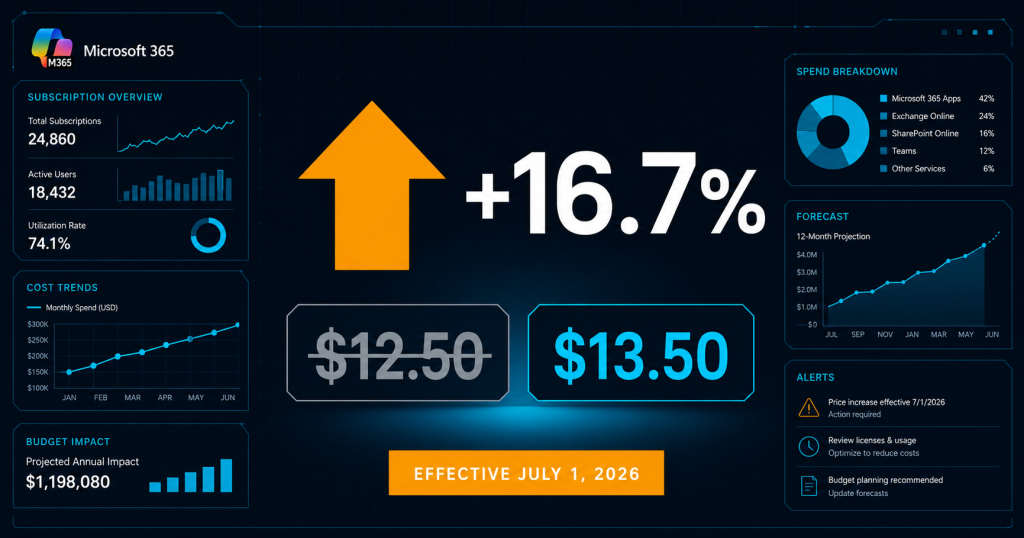
- $720/year more for a 20-person Microsoft 365 E3 team at July 2026 rates — Microsoft Licensing News, Feb 2026
- $3,000/year more for a 50-person Office 365 E3 organization — same official source
- Business Premium is explicitly excluded — $22.00 per user per month, unchanged
- Microsoft 365 F1 sees the largest increase at 33.3% — from $2.25 to $3.00 per user per month
- Renewing before July 1 locks in current pricing for your full next contract term
- 48% of businesses on monthly billing pay a 5% premium on top of the base increase
- Copilot Chat (basic) is bundled in — full Microsoft 365 Copilot remains $30/user/month extra
- Microsoft’s increases run 2–12x the general CPI rate of 2.7% — BLS, January 2026
A 20-person team on Microsoft 365 E3 pays $720 more per year starting July 1, 2026. A 50-person Office 365 E3 organization pays $3,000 more. Those numbers take effect at your next renewal after that date — whether you planned for it or not. Before you dismiss this as another price increase to absorb, the renewal timing matters: if your contract renews before July 1, you lock in current rates for the full next term. That window is closing.
What Microsoft Confirmed About the July 2026 Increase — and What Third-Party Coverage Got Wrong
Microsoft confirmed global commercial price increases effective July 1, 2026 across select Microsoft 365 suites and standalone components. The confirmation came in three separate official publications between December 2025 and March 2026 — all linked in the sources section below. Business Premium carries no price change. Multiple third-party articles reporting it as increasing to $24.50 are factually wrong.
The December 4, 2025 Microsoft 365 Blog announcement established the framework: AI feature bundling — Copilot Chat, expanded Defender capabilities, additional storage — as the stated justification for the increases. The February 16, 2026 Microsoft Licensing News page published the complete per-SKU price table with exact before-and-after figures. The March 24, 2026 FAQ confirmed that the July 1 date applies to both new purchases and existing customers at their next renewal after that date.
One correction that matters operationally: several widely-circulated articles have reported Microsoft 365 Business Premium as increasing to $24.50 per user per month. Microsoft’s official licensing page states explicitly that Business Premium carries no price change. It remains $22.00 per user per month. Verify this against the official Microsoft source before any renewal decisions based on third-party coverage.
The plans confirmed unchanged per Microsoft’s official table: Business Premium ($22.00), Office 365 E1 ($10.00), Microsoft Purview Suite ($12.00), and Microsoft Defender Suite ($12.00). Standalone Microsoft Teams SKUs are also excluded. If your operation is on any of these, no action is required specifically in response to this announcement.
Your Exact Dollar Increase by Plan and Seat Count
Percentages are useful for headlines. Dollar totals are what show up on invoices. The tables below use current and new per-user per-month prices from Microsoft’s official February 2026 licensing page, applied to the most common operator seat counts. Every number is sourced to the primary Microsoft publication — no estimates, no projections.
Microsoft 365 Business Plans
| Plan | Current /user/mo | New /user/mo | Increase | % change |
|---|---|---|---|---|
| Microsoft 365 Business Basic | $6.00 | $7.20 | +$1.20 | +20% |
| Microsoft 365 Business Standard | $12.50 | $13.50 | +$1.00 | +8% |
| Microsoft 365 Business Premium | $22.00 | $22.00 | $0 | 0% — unchanged |
| Microsoft 365 Apps for Business | $8.25 | $10.00 | +$1.75 | +21% |
Microsoft 365 Enterprise Plans
| Plan | Current /user/mo | New /user/mo | Increase | % change |
|---|---|---|---|---|
| Microsoft 365 E3 | $36.00 | $39.00 | +$3.00 | +8.3% |
| Microsoft 365 E5 | $57.00 | $60.00 | +$3.00 | +5.3% |
| Office 365 E3 | $23.00 | $28.00 | +$5.00 | +21.7% |
| Office 365 E1 | $10.00 | $10.00 | $0 | 0% — unchanged |
| Microsoft 365 F1 | $2.25 | $3.00 | +$0.75 | +33.3% |
| Microsoft 365 F3 | $8.00 | $10.00 | +$2.00 | +25% |
Dollar impact at common seat counts for the most affected plans:
10-person Business Basic team: $144 more per year ($6.00 → $7.20 × 10 × 12).
10-person Business Standard team: $120 more per year ($12.50 → $13.50 × 10 × 12).
20-person E3 team: $720 more per year ($36.00 → $39.00 × 20 × 12).
50-person Office 365 E3 organization: $3,000 more per year ($23.00 → $28.00 × 50 × 12).
50-person F3 frontline team: $1,200 more per year ($8.00 → $10.00 × 50 × 12).
The Three Billing Models — Why Your Invoice May Be Higher Than the Table Shows
The prices in the table above are annual-commit, billed annually — the baseline. Two other billing models exist and both produce higher effective rates. Microsoft introduced a 5% premium for monthly billing on annual-commit contracts in April 2026. Month-to-month contracts carry a 20% premium over the annual-commit baseline. The July 1 increases compound on top of whichever model you are currently on.
Annual-commit, billed annually (baseline): These are the figures in the tables above. One invoice per year at the annual rate. If your contract renews after July 1, 2026, you pay the new annual rate at renewal. This is the cheapest model and the figures most commonly reported in coverage of this announcement.
Annual-commit, billed monthly (add approximately 5%): Microsoft’s April 2026 update added a 5% premium for monthly billing on annual commitments. A 20-person E3 team currently paying monthly on an annual commit pays approximately $9,072 per year — and will pay approximately $9,828 after July 1. The delta is approximately $756 versus the $720 baseline. If you are on this model, use that higher figure in your budget calculations.
Month-to-month (add approximately 20%): Month-to-month contracts carry a 20% premium over the annual-commit rate. The July 1 event is a natural trigger to run the annual billing math. Switching a 20-person Business Standard team from monthly to annual billing currently saves approximately $90 per year at existing rates — and that savings partially offsets the July 1 increase under either model.
Why Business Premium Is Unchanged — and Whether the Upgrade Math Works for Your Operation
Business Premium is explicitly excluded from the July 1 increases. At the unchanged $22.00 per user per month, the gap between Business Standard and Business Premium narrows from $9.50 to $8.50 per user per month post-July 1. Business Premium includes Defender for Business, Intune, and Azure AD Premium P1 — the same capabilities Microsoft is bundling into Enterprise plans to justify their increases.
For operations under 300 users, the comparison is worth running before your next renewal conversation. The per-seat annual math:
| Scenario | Cost/user/mo (post-July) | 20-seat annual total | Delta vs Business Premium |
|---|---|---|---|
| Stay on Business Standard | $13.50 | $3,240 | — |
| Upgrade to Business Premium | $22.00 | $5,280 | +$2,040/year |
| Stay on E3 (post-July) | $39.00 | $9,360 | +$4,080 vs Business Premium |
Business Premium at $2,040 more annually than Business Standard delivers Defender for Business, Intune device management, and Azure AD Premium P1. Licensing those separately for a 20-person team costs significantly more. For operations with device management and security requirements currently pushing them toward E-tier licensing, this comparison often resolves in favor of Business Premium at the unchanged $22.00 rate.
The Copilot Question: What Is Actually Bundled and What Still Costs $30 Per User Per Month
Microsoft is bundling Copilot Chat — the basic AI assistant inside Teams, Outlook, and the Microsoft 365 web interface — into affected suite tiers. This is not the same as Microsoft 365 Copilot, which generates full documents in Word, creates PowerPoint presentations from briefs, analyzes Excel datasets, and manages inbox workflows. Full Copilot remains a separate $30 per user per month add-on, completely unaffected by the July 1 price changes.
What Copilot Chat (bundled) actually does: Answers natural language questions about your emails, documents, and calendar inside Teams and Outlook. Summarizes meetings you missed. Drafts short replies based on thread context. It cannot generate full documents from scratch, analyze large datasets independently, or run multi-step agentic workflows. This is the basic assistant tier.
What Microsoft 365 Copilot (not bundled, $30/user/month) actually does: Generates complete documents in Word from a brief. Creates full presentations in PowerPoint. Analyzes and explains data in Excel. Drafts and organizes your inbox. Attends meetings to take notes and produce action items. This is what most operators think of when they hear “Microsoft Copilot.”
If your team has been evaluating whether to add full Microsoft 365 Copilot, that decision is unaffected by the July 1 price changes. The bundled Copilot Chat is a different product. The $30 add-on remains the same price. For a broader view of how AI tools compare across your entire stack — not just Microsoft — see our analysis of Claude vs ChatGPT for business operators.
When the Increase Actually Hits Your Invoice — The Renewal Timing Detail
July 1, 2026 is not the date your bill changes. It is the date new pricing activates for new purchases and renewals. If your annual contract renews on June 15, 2026, you pay current rates for the full next 12-month term. If it renews on August 15, 2026, you pay new rates starting that date. The delta between those two scenarios for a 20-person E3 team is $720 per year. This is the same pattern Microsoft followed when GitHub Copilot shifted to usage-based billing — pricing changes lock in at the next renewal, not the announcement date.
Early renewal is available through most Microsoft CSP resellers and direct Microsoft account managers. The standard window is 30 to 90 days before your contract expiration date. Resellers are reporting higher than normal early renewal volume ahead of July 1, and processing times are longer than usual. Contact your reseller now rather than waiting for the renewal notification email — it may arrive too close to the July 1 date to leave meaningful decision time.
One additional complexity: Microsoft introduced a new pricing structure in April 2026 that charges a 5% premium for annual-commit contracts billed monthly versus annually. If you currently pay monthly on an annual commitment, your effective rate is already 5% above the base listed price, and the July 1 increases compound on top of that. This is the billing model audit that pays off most quickly for operations currently on monthly billing for an annual commitment.
What to Do Before July 1 — Five Actions in Order of Impact
Five specific actions. Ordered by the operators most likely to see dollar impact first. Action 1 costs zero dollars and takes two minutes. Action 5 requires a conversation with your reseller. Between those two endpoints, every action produces measurable dollar outcomes that can be quantified before you take the next step.
Action 1 — Confirm your renewal date today. Log into the Microsoft 365 admin center under Billing or contact your CSP reseller. Get the exact renewal date. Write it down. If it falls before July 1, 2026, you are protected for another full term at current rates. If it falls after July 1, you have a decision to make and a window to act in. This takes two minutes and determines everything else on this list.
Action 2 — Run a 15-minute feature usage audit. Navigate to Reports in the Microsoft 365 admin center and pull the last 30 days of activity data. Which apps are actually being used week over week? Copilot Chat will be bundled into your plan — if your team does not use Teams or Outlook AI features, the bundled value adds zero practical benefit. The audit takes 15 minutes and tells you whether the bundled features justify the increase for your operation.
Action 3 — Run the Business Premium comparison. If you are on Business Standard or Basic, calculate the per-seat annual cost at your seat count for your current plan post-July 1 versus Business Premium at the unchanged $22.00. Use the tables above. For operations under 300 users with device management or security requirements, this comparison often resolves in favor of Business Premium. Do this before your reseller calls you with a renewal proposal.
Action 4 — Audit your billing model commitment. If you are on annual-commit billed monthly or month-to-month, the July 1 event is a natural trigger to run the annual billing math. Switching from monthly billing to annual billing on an annual commit eliminates the 5% monthly premium. That savings partially offsets the July 1 increase and reduces your exposure to future price changes on the same contract.
Action 5 — Contact your CSP reseller before June 1. Regardless of your renewal date, contacting your reseller before June 1 ensures you have time to review the renewal terms, compare plan options, and execute the paperwork before reseller capacity tightens in late June. Do not wait for the renewal notification email. For managing your broader AI tool stack spend in parallel with this Microsoft review, see our analysis of ChatGPT workspace agents for business operators.
Three Failure Modes That Cost Operators Money
July 1 is not a billing date — it is an activation date for renewals. Microsoft’s official FAQ confirms: existing customers see new pricing at their next renewal after July 1, not on July 1 itself. Operators who do not check their renewal date assume they have time they may not have — or panic-renew when they were already protected.
The price tables show annual-commit, billed-annually rates — the baseline. Monthly billing on an annual commitment adds 5%. Month-to-month adds 20%. Operators calculating their exposure from the percentage headlines without confirming their billing model consistently underestimate the actual invoice impact.
Multiple published articles state Microsoft 365 Business Premium is increasing to $24.50 per user per month. Microsoft’s official licensing page explicitly contradicts this. Business Premium is $22.00 and carries no price change. Renewal decisions made on incorrect pricing data waste negotiating leverage and create false budget projections.
Microsoft 365 commercial prices increase July 1, 2026. Most plans up 5% to 33%. Business Premium is unchanged at $22.00. A 20-person E3 team pays $720 more per year. Copilot Chat basic is bundled in — the full $30/user/month Copilot is still separate. The one lever before July 1: confirm your renewal date today. If it falls after July 1, contact your reseller this week. For operators evaluating their complete AI tool spend alongside this Microsoft increase, our comparison of Claude vs ChatGPT for business runs the same dollar-impact analysis across the tools most likely sitting in your stack right now.
No. Business Premium is explicitly excluded from the July 1, 2026 price increases and remains $22.00 per user per month. Multiple third-party articles have incorrectly reported Business Premium increasing to $24.50 — this is factually wrong. Verify against Microsoft’s official Licensing News page before making renewal decisions based on third-party coverage.
Your bill increases at your next renewal date on or after July 1, 2026. If your contract renews June 15, 2026, you pay current rates for another full 12-month term. If it renews August 15, 2026, you pay new rates at that renewal. Confirm your exact renewal date in the Microsoft 365 admin center under Billing.
No. Microsoft is bundling Copilot Chat — the basic AI assistant in Teams and Outlook — into affected plans. Full Microsoft 365 Copilot, which generates documents, analyzes Excel, and creates presentations, remains a separate $30 per user per month add-on. The bundled and paid versions are different products with different capability levels.
Business Premium ($22.00), Office 365 E1 ($10.00), Purview Suite ($12.00), and Defender Suite ($12.00) are all confirmed unchanged per Microsoft’s official licensing page. Standalone Microsoft Teams and standalone Copilot SKUs are also excluded. If you are on any of these plans, no renewal action is required in response to the July 1 announcement.
Yes. Renewing before July 1, 2026 locks in current pricing for your full next renewal term — typically 12 months. Most CSP resellers allow early renewal 30 to 90 days before your expiration date. Contact your reseller now, as processing times are longer than usual. Check the Microsoft 365 admin center under Billing for direct renewal options.
General U.S. consumer prices rose 2.7% December 2024 to December 2025 per the Bureau of Labor Statistics. Microsoft’s increases range from 5.3% on E5 to 33.3% on F1 — between two and twelve times the general inflation rate. Business Basic at 20% is roughly eight times CPI. Useful context for presenting renewal costs to finance or ownership.
For operations under 300 users, run the comparison before your renewal. Business Premium at the unchanged $22.00 includes Defender for Business, Intune, and Azure AD Premium P1 — the same capabilities Microsoft is bundling into Enterprise plans to justify price increases. If your operation needs those features, Business Premium often costs less per seat than E3 post-July 1.
Microsoft has not officially announced any pricing changes beyond July 1, 2026. Community discussion references speculation about a potential second increase in January 2027, but this is unconfirmed. Treat it as unconfirmed until Microsoft publishes official documentation. FutureAIStack will update this article if additional pricing changes are announced.
Sources
-
Microsoft 365 Blog — Advancing Microsoft 365: New Capabilities and Pricing Update
Primary Microsoft announcement confirming global commercial pricing update effective July 1, 2026 across select Microsoft 365 commercial suites. Confirms Copilot Chat bundling rationale. Confirms July 1 effective date.
microsoft.com — Published December 4, 2025 -
Microsoft Licensing News — 2026 M365 Packaging and Pricing Updates
Official per-SKU price table confirming exact before-and-after prices for all affected plans. Explicitly confirms Business Premium, Office 365 E1, Purview Suite, and Defender Suite carry no price change. Source for all pricing tables and dollar calculations in this article.
microsoft.com — Published February 16, 2026 -
Microsoft Licensing FAQ — 2026 M365 Packaging and Pricing Updates
Official FAQ confirming July 1, 2026 effective date applies to both new and renewing customers globally. Confirms existing customers see new pricing at their next renewal after July 1. Source for the renewal timing section.
microsoft.com — Published March 24, 2026 -
U.S. Bureau of Labor Statistics — Consumer Price Index: 2025 in Review
Confirms CPI all-items rose 2.7% from December 2024 to December 2025. Baseline for contextualizing Microsoft’s 5% to 33% increases against broader economic conditions in the same period.
bls.gov — Published January 20, 2026
The AI tools and stack changes that actually affect your business costs — delivered weekly. No fluff. No hype.
Get weekly updates